

Our Stu – improvisor and owner of a ‘B’ in GCSE physics – attempts to science the sh*t out of improv.
It’s a little know fact that Albert Einstein used improv sets to help prove his revolutionary theory of general relativity to the scientific community. In fact, I would say that it’s such a little know fact that it’s not know at all.
Not to worry. I will attempt to explain as best I can.
As you will know, Einstein established that time runs slower in stronger gravitational fields because gravity warps spacetime by mass and energy.
This means that the closer you are to a giant mass like the Earth, the faster time passes. In practical terms it is why satellites zooming particularly high above our planet must adjust their clocks to compensate for the weaker gravity relative to Earth’s surface.
The same applies to the Sun. The Sun has a colossal mass and is a gargantuan energy ball which gives it a might big dose of gravity. That gravity bends spacetime and results in time passing faster on Mercury, the closest planet to the Sun, than it does back here on home soil.
This is gravitational time dilation.
At this point I’m guessing you’re wondering what this has to do with improv?
Many people in white coats asked Einstein exactly the same question.
Einstein knew – like any seasoned improvisor now knows – that every improv scene generates its own gravity by the mass of its participants and the vast amounts of energy emitted whilst trying to make stuff up. The build up of the mass and energy creates gravity which then bends the fabric of spacetime around the improv scene.
This results in time passing quicker for the improvisor but slower for the audience members watching the improv scene, set or show. Put simply the closer you are to the centre of an improv scene, the faster time passes. Conversely, the further away you are from an improv scene, the slower time passes. Therefore, in conclusion, time passes slower for the audience than it does for the improvisor.
Here, I’ve drawn you a graph with coloured pens I found in a kitchen draw (see fig. 1).
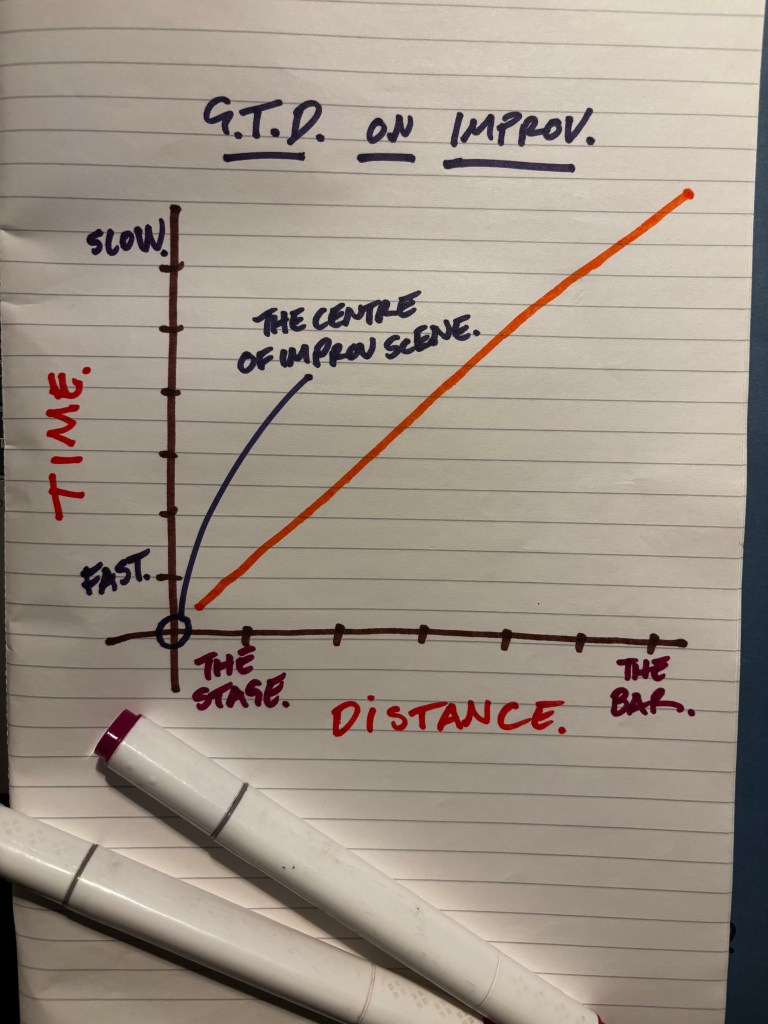
(fig. 1)
So, what I’m basically saying is that you (the improvisor) are Matthew McConaughey and the audience is your 86-year-old daughter on her death bed.
I have to admit, it does sound far fetched and that’s because it is.
Many of Einstein’s scientific piers had their doubts too when he asked them to take part in his long-form improv experiments in front of an audience of fellow maths and physics boffins.
However, all of the doubting eggheads agreed in their pier reviewed conclusions that time did seem to fly by when they were performing improv. Some of them couldn’t even remember what the hell they had said or did whilst on stage.
Meanwhile, the brain-box audiences concluded that the performing scientists were going at it at hundred-miles per hour, talking over each other, not listening to what their scene partner was saying, and simply not collaborating in the same reality. They all agreed that every performance would benefit from a bit of quiet contemplation and moments of silence.
Of course, each experiment had a control group in which the scientists on stage just sat and knitted Dr Who scarfs whilst the audience watched. They all agreed that it was quite pleasant and relaxing but after a while time dragged for everyone involved.
Hence, Einstein’s own conclusion was that time runs slower in the stronger gravitational (improv) fields because gravity warps spacetime by mass (scene partners) and energy (making shit up).
At this point I’m guessing you’re wondering what this has to do with your improv?
Well, it’s my stupid way of telling you to slow down.
You have time.
Remember, as a performer you are closest to the gravity of the improv scene. Time runs faster for you.
What seems to you like a horribly long pause for thought, is a matter of milliseconds.
So, take your time.
Don’t be in a rush to fill those moments of silence with garbled words and ideas.
Listen to your scene partner’s every last word and pause before you reply.
You don’t have to go with the first thing that pops into your head. You’ve got time to go with a new choice, which is why there is an improv game actually called ‘new choice’. Your second, third or fourth idea can be an absolute improv peach. But you’ll only get to it if you take the time to.
Breath.
Take it all in.
Time is relative – and precious.
 The Oickers